
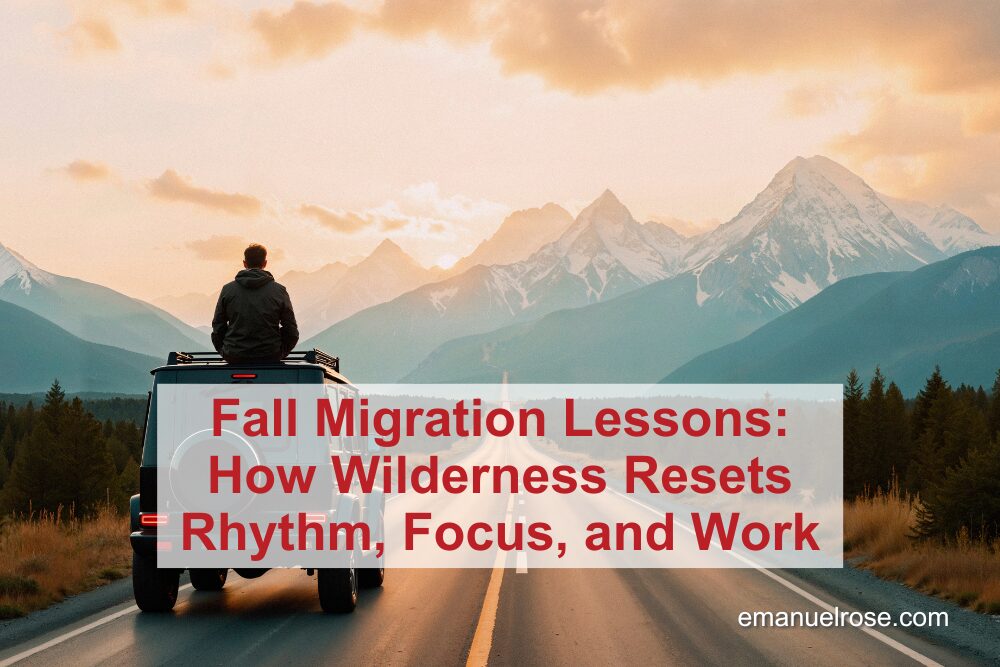
Eight weeks on the road, living out of a tent from Reno to Saskatchewan and back, stripped life down to weather, wildlife, and the subsequent decision in front of me. That slower rhythm became a working model for mindful leadership, creative depth, and sustainable productivity.
- Build a daily “field rhythm” at home by anchoring your day around dawn or dusk time outside, even if it is just a walk around the block.
- Practice single-decision focus: when you feel scattered, ask only, “What is the next right move?”—the same way you would decide where to camp or hunt.
- Schedule intentional solitude blocks on your calendar as you would a meeting, protecting at least one period each week where you are offline and outdoors.
- Let weather be a teacher: notice how heat, cold, and discomfort change your mood and choices, then adjust your self-care and workload accordingly.
- Use a “migration” mindset for projects—plan, gear up, commit to a route, stay flexible to conditions, and allow recovery time at the end.
- Reclaim a slower pace by deliberately saying no to nonessential obligations so you can keep space for reflection, journaling, and being on your own internal schedule.
- Remember that wilderness carries risk; manage it with preparation and humility so you can keep returning to the field season after season.
The Migration Rhythm Loop: A Six-Step Wilderness Framework
Step 1:
Answer the pull to move. For me, that began with loading the Xterra with decoys, shotguns, fly rods, and a twelve-year-old dog, knowing I would be gone for weeks without resupply. Saying yes to that kind of trip is the first discipline: committing to leave comfort and predictability behind.
Step 2:
Strip life down to essentials. On the road, everything is reduced to fuel, shelter, water, and the next place to camp. That simplicity exposes what actually matters—health, attention, safety, and a clear head—which is a powerful filter for what you allow back into your life once you return.
Step 3:
Let the landscape set your pace. Jarbridge, Targhee, Saskatchewan, Hungry Horse, Hepner, the Owyhee—each landscape demanded a different rhythm tied to weather, terrain, and wildlife. When you let the land lead, you stop forcing your own tempo and start tuning to something older and wiser than a calendar.
Step 4:
Lean into solitude before rejoining the campfire. Long stretches alone with Tex and the sound of elk bugling at night gave way to bursts of social hunting camps and shared meals. The transition between being alone and being with others is a practice in itself—how you carry stillness into conversation and don’t lose yourself in group noise.
Step 5:
Study your tools until they disappear. By the time I was deep into the trip, the tent, heater, stove, and sleeping system were dialed in enough that they faded into the background. At that point, gear stops being a distraction and becomes a quiet foundation for presence, work, and play.
Step 6:
Return, integrate, and recalibrate. Coming back in early November, I felt how busy everyone was compared to the hunting schedule I had been on. The real work is protecting the slower migration rhythm at home—saying no more often, guarding time for thoughtfulness, and letting the season in the field reshape how you operate the rest of the year.
From Highway to Trailhead: Translating Field Lessons into Daily Life
Wilderness Experience | Core Lesson | Everyday Application | Risk if Ignored |
|---|---|---|---|
Solo hunting and camping across thousands of miles | Self-reliance through transparent, sequential decision-making | Break complex projects into the next visible step instead of trying to solve everything at once | Overwhelm, paralysis, and reactive choices driven by stress instead of intention |
Living on a hunting and hiking schedule, not a clock | Aligning your pace with natural cycles improves clarity and energy | Anchor work and family life around a few daily nature cues—sunrise, sunset, temperature, or moon phases | Constant over-scheduling, shallow thinking, and a sense that time is always getting away from you |
Taking a hard fall on the last day of the trip | Adventure carries real risk; humility and preparation keep you in the game | Plan safety margins into your ambitions—rest days, backup plans, and honest assessments of your limits | Injury, burnout, or business setbacks that could have been prevented with a bit more foresight |
Field-Born Questions to Recenter Your Life and Work
What is my current “season,” and am I living in rhythm with it or against it?
Out in Saskatchewan or the Owyhee, the season is obvious—heat, frost, and animal movement tell the truth. Ask yourself whether you are in a season of building, recovering, or transitioning, and then tune your commitments and energy output to match that reality.
Where am I carrying unnecessary weight—physically, mentally, or emotionally?
On an eight-week migration, every piece of gear has to earn its place in the rig. Bring that same scrutiny to your schedule, relationships, and mental habits, letting go of what you no longer need so you can move farther with less strain.
When was the last time I was truly alone with my thoughts, without a screen?
Driving long stretches and sitting in camp without audiobooks or constant media forces you to listen to your own internal signal. Start with short, intentional periods—twenty or thirty minutes on a walk or in a chair outside—and notice what surfaces when you remove input.
What is my version of the “Hunter’s Moon”—a recurring natural event that can anchor reflection?
That bright, full autumn moon over the reservoir and the Hepner hills became a visual reminder to pause, notice, and take stock. Choose a natural marker—a monthly moon phase, the first frost, or the first spring bloom—and use it as a recurring cue to journal, reassess goals, and reset priorities.
How am I balancing risk and reward in my adventures and my business decisions? Being out in deep canyons or remote wilderness with a dog and a loaded rig brings very real consequences to sloppy choices. Translate that awareness into your professional life by running simple risk checks before big moves, then stepping forward anyway with courage, preparation, and respect for the unknown.
Author: Emanuel Rose, Senior Marketing Executive, Strategic eMarketing
Contact: https://www.linkedin.com/in/b2b-leadgeneration/
Last updated:
- “One Dog, One Man, One Season” (referenced as “One Dog”) — my book on upland hunting with Tex and the lessons carried out of the field.
- Jarbridge Wilderness, Targhee area, Saskatchewan prairies, Hungry Horse Reservoir, Hepner, and the Owyhee Canyonlands as lived case studies in solitude, risk, and perspective.
- Mindfulness and introspection practices reinforced by long stretches offline, relying only occasionally on tools like Starlink to bridge work and wilderness.
- The Seven Principles of the Magic Rock as a complementary framework for gratitude and awareness in nature-based living.
- Personal field systems for gear, safety, and camp setup refined across an eight-week migration to support focus and resilience.
About Strategic eMarketing: Strategic eMarketing helps growth-minded organizations design and execute data-informed, story-driven marketing systems that generate leads and deepen customer loyalty.
https://strategicemarketing.com/about
https://www.linkedin.com/company/strategic-emarketing
https://podcasts.apple.com/us/podcast/marketing-in-the-age-of-ai
https://open.spotify.com/show/marketing-in-the-age-of-ai
https://www.youtube.com/@EmanuelRose
About the Host
Emanuel Rose is a senior marketing executive, author, and lifelong hunter and angler who splits his time between strategic campaigns and backcountry trailheads. He helps brands tell truer stories while advocating for a nature-centered lifestyle that keeps people grounded and creative. Connect on LinkedIn: https://www.linkedin.com/in/b2b-leadgeneration/
Trailhead for Change: Bringing Migration Wisdom Home
You do not need eight weeks on the road to reclaim a wilder rhythm; you can start with one morning outside, one weekend camping trip, or one hour alone under the night sky. Choose a simple action—an early walk, a no-screen evening on the porch, a short overnight in a nearby wild place—and treat it as your own small migration away from distraction and back toward yourself.
From there, let the lessons accumulate: listen more, move slower, decide cleaner, and remember that you are at your best when your life has enough open sky and quiet ground under your feet.
Watch the podcast episode: https://youtu.be/qMj2ziq52_M