
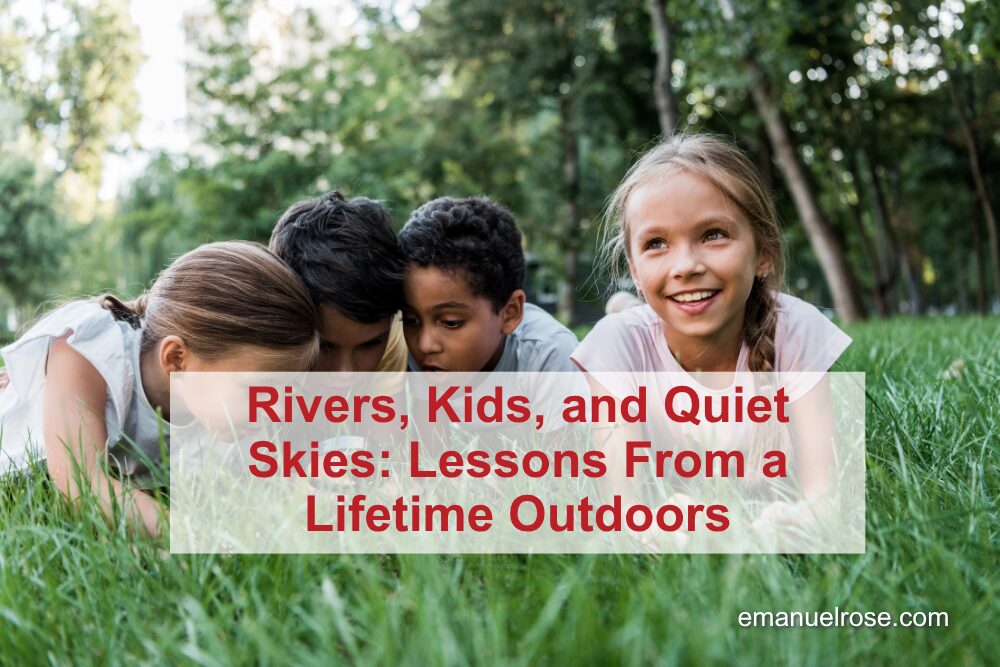
Decades on wild rivers reveal a simple truth: time outside heals us, hardens soft edges in the best way, and reminds us we belong to something larger than our screens and schedules. When we share those places with kids and new travelers, we not only restore ourselves but also grow the next generation of caretakers.
- Design intentional “unplugged zones” in your week: daily walks without a phone, or one tech-free evening under the stars each month.
- Plan at least one multi-day trip each year where cell coverage drops out, and your body resets to the rhythm of light, water, and weather.
- Take a young person outside—camp, raft, hike, or even just throw rocks in a river—and let nature, not an agenda, lead the experience.
- Use every encounter with water, forests, and wildlife to ask, “Where did this come from, and what happens to it after it leaves my sight?”
- Choose outfitters and guides who work with local experts and respect the place, so your travel dollars reinforce conservation and culture.
- Treat wild trips as leadership training: practice calm decision-making, shared risk, and humility in the face of changing conditions.
- Notice how you feel after a day outdoors, then bring that grounded energy back into your family, team, and community.
The Six-River Loop: A Nature-Based Framework for Real Adventure
Step 1:
Redefine what adventure means for you and your family. Peter sees that fewer people want to sleep on the ground or run class IV rapids, yet real growth still happens at the edge of comfort. Decide where that edge is now, not where marketing tells you it should be.
Step 2:
Guard disconnection as a sacred part of the journey. On many trips, the hardest work now is not navigating rapids, but navigating connectivity—Starlink, satellite phones, and constant reachability. Choose trips, days, and moments where you consciously leave the grid and reclaim silence.
Step 3:
Let wild places do the teaching. Whether you are on the Salmon’s white sand beaches or deep in the Owyhee “big empty,” nature is already a curriculum in resilience, humility, and wonder. Your job is to show up, pay attention, and follow the cues of wind, current, and sky.
Step 4:
Build family rites of passage on rivers and trails. The Family Magic trips work because kids and adults share the same sand, same stars, and the same sense of discovery, with a guide leading nature games as the anchor. You can recreate this pattern on any weekend outing: shared camp, shared stories, shared effort.
Step 5:
Connect your personal joy to planetary responsibility. When you stand in the Congo Basin rainforest or watch a free-flowing river slide by, it becomes harder to ignore where your paper, fuel, and water come from. Use that visceral connection to fuel better choices and conversations back home.
Step 6:
Invest in people as much as places. Peter’s deepest “bucket list” is not a new river, but staying important in other people’s lives—especially young guides learning leadership on the water. Treat every trip as a chance to mentor, model good stewardship, and multiply the impact far beyond your own experience.
From Screen Glow to Starlight: A Practical Comparison
Dimension | Screen-Centered Routine | Nature-Immersed Trip | Realistic Daily Shift |
|---|---|---|---|
Attention | Fragmented by notifications and constant connectivity. | Focused on current, weather, wildlife, and the people around you. | Set one “no notifications” walk or sit-spot each day for 20–30 minutes. |
Family Dynamics | Shared space, separate worlds; everyone on different devices. | Shared challenges, shared beaches, and shared stories under one sky. | Institute a weekly tech-free meal or evening where stories replace screens. |
Sense of Scale | Life shrinks to deadlines, headlines, and online drama. | Star fields, canyons, and long river corridors restore perspective. | Regularly seek dark skies or wide horizons to remember how small—and connected—you are. |
Deep River Questions: Insights for Grounded Growth
How does remoteness change the way we see ourselves and our problems?
Standing in places like the Owyhee canyons or the Congo Basin, your usual worries feel smaller against geologic time and ecological scale. That shift is not escapism; it is recalibration, helping you return home with a clearer sense of what truly matters and what can be released.
Why is it so important for kids to experience wild rivers and starry skies?
When kids spend days on a river, building sandcastles and falling asleep under a sky free of city light, their nervous systems reset to a healthier rhythm. Those embodied memories of joy, challenge, and wonder become a lifelong reference point that no screen can substitute.
What can we learn from guides who return to the same rivers year after year?
A seasoned guide reads subtle changes in flow, weather, and human dynamics, and responds without drama. That kind of presence comes from repetition in nature, and it translates directly to leadership off the river: seeing patterns, staying calm when levels change, and making decisions that respect both people and place.
How does travel with local guides deepen our connection to a landscape?
Local guides are culture-bearers and storytellers; they open doors you would never find on your own. When you pair physical immersion—paddling, hiking, snorkeling—with their insight, you move from being a consumer of scenery to a respectful learner in someone else’s home.
What does it mean to “value” a river beyond its economic use?
A free-flowing river is worth more than the sum of its hydropower, irrigation, or recreation revenue; it is a living system that shapes forests, wildlife, and the human spirit. Valuing it means asking what is lost when that movement stops, and choosing policies and personal habits that keep its pulse alive.
Author: Emanuel Rose, Senior Marketing Executive, Strategic eMarketing
Contact: https://www.linkedin.com/in/b2b-leadgeneration/
Last updated:
- Seven Principles of the Magic Rock, by Emanuel Rose – a practical framework for gratitude and grounded living.
- Nature Bound Podcast conversation with Peter Grubb on guiding, rivers, and conservation.
- Family Magic trips on the Salmon River, an example of structured, kid-centered wilderness immersion.
- ROW Adventures, Sea Kayak Adventures, and Adventure Unbound are models of nature-based travel aligned with local expertise.
- Board service experiences with Idaho Rivers United and related conservation organizations, informing advocacy for free-flowing rivers.
About Strategic eMarketing: Strategic eMarketing helps mission-driven brands, outdoor companies, and professional practices develop clear positioning and achieve measurable growth through an integrated marketing strategy and content.
https://strategicemarketing.com/about
https://www.linkedin.com/company/strategic-emarketing
https://podcasts.apple.com/us/podcast/nature-bound-with-emanuel-rose/id1741980361
https://open.spotify.com/show/6v7x8XOUfUQDdAlloCoo0h
https://www.youtube.com/channel/UC7Ax4n0g6_Y4SJRlC470wEg
Guest Spotlight
Guest: Peter Grubb
LinkedIn: https://www.linkedin.com/in/peter-grubb-2a7296b/
Companies: ROW Adventures, Sea Kayak Adventures, Adventure Unbound (including Cuba Unbound)
Episode: Nature Bound Podcast conversation recorded Tuesday, February 3rd, 2026, at 2:00 PM PST, focusing on rivers, guiding, and the responsibility of travel.
Bio: Peter has been guiding professionally for 49 years and has spent 47 of those as an outfitter and tour operator, steering his companies through events such as 9/11, recessions, border conflict, and wildfires. He builds journeys that blend rafting, yachting, kayaking, and cultural immersion with a steady commitment to rivers, conservation, and the people who call these landscapes home.
About the Host
Emanuel Rose is an outdoor-focused marketing strategist, the author of “The Seven Principles of the Magic Rock,” and the host of Nature Bound, where he explores how time spent outside strengthens mental health, creativity, and leadership. Connect with him on LinkedIn: https://www.linkedin.com/in/b2b-leadgeneration/.
Carry the River Home: Applying the Lessons Now
You do not need a passport or a multi-day raft permit to start; you only need a decision to trade glow for starlight and noise for running water, even for a short window each week. Take a kid, a friend, or a young colleague outside, let the land set the agenda, and notice how that shared experience sharpens your sense of responsibility to the rivers, forests, and skies that sustain us.